How We Train Dogs: Our Philosophy, Methods, and Why Every Dog Is Different
By Terra, Licensed Family Dog Mediator® (LFDM) & Certified Trick Dog Instructor (CTDI) · Wholistic Canine · Sacramento, CA
TL;DR
We don't start by choosing a training method. We start by understanding the dog, understanding the owner, and choosing the approach that gives both the greatest chance of success. No labels, no one-size-fits-all programs — just an honest look at the whole dog: genetics, environment, learning history, and the individual in front of us.
Every week, someone calls us and asks some version of the same question: "Are you positive reinforcement or balanced?"
It's a fair question. Dog training has gotten so polarized that owners feel like they have to pick a side before they even pick a trainer. But here's the honest answer: we don't fit neatly into either box, and that's on purpose.
Asking "What method do you use?" before meeting the dog is like asking a doctor "What medication do you prescribe?" before the exam. A good answer doesn't exist yet. The dog hasn't walked in the door.
So instead of giving you a label, we want to give you something more useful: a real explanation of how we think about dogs, how we make training decisions, and why the dog in front of us always matters more than any philosophy we could put on a business card.
Why "Wholistic"? Because Obedience Is the Smallest Part of the Picture
Wholistic Canine has never been about teaching dogs commands. Sit, down, stay — those are the easy part. Most of the dogs we meet already know plenty of "commands."
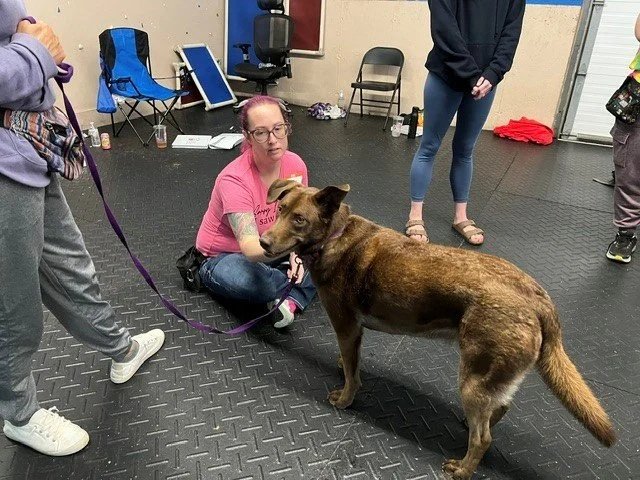
What we actually do is help owners understand why they aren't getting the relationship they envisioned with their dog. And that answer almost never lives inside a training method. It lives in the whole dog: genetics, nutrition, lifestyle, learning history, environment, temperament — and just as often, in the human side of the leash.
That's the "wholistic" in our name. Training is one piece of helping dogs and people communicate better. It's an important piece. But it's never the whole picture.
Which is why, at our core, we're canine relationship coaches. When people ask what matters more — the relationship or the method — the answer is always the relationship. Understanding the dog comes first. Methods and tools get chosen after the relationship and communication are understood, never before.
The Backbone of How We Assess Dogs: L.E.G.S.®
When we evaluate a dog, we're working through a framework called L.E.G.S.®, developed by applied ethologist Kim Brophey — you may know her from her book Meet Your Dog. Terra is a Licensed Family Dog Mediator® (LFDM), and this lens shapes how our whole team looks at every dog that walks through the door — no matter which trainer you work with.
L.E.G.S. stands for four things that are shaping your dog's behavior every single day:
L Learning — everything your dog has ever been taught, on purpose or by accident. Their entire learning history, not just their last training class.
E Environment — where your dog lives, what their daily life looks like, your household, your schedule, your neighborhood.
G Genetics — what your dog was bred to do for generations. A herding dog herds. A guardian breed guards. You can't train DNA out of a dog.
S Self — this individual dog. Their age, health, temperament, and personality. No two dogs are the same, even littermates.
Here's why this matters for you: if every dog's L.E.G.S. are different, then no single training method can possibly fit every dog. The method has to be chosen after we understand the dog — never before.
Why We Don't Wear a Training Label
Trainers argue about labels the way people argue about politics. Most of us actually want the same things — happy dogs, successful owners, humane treatment — but we disagree loudly about how to get there. Labels flatten a genuinely complex profession into team jerseys.
And for owners, labels mostly create confusion. There's no universal regulation in dog training and no consistent definition behind most of these terms — that's a whole conversation of its own (coming soon). Two "positive reinforcement" trainers can run completely different programs. Two "balanced" trainers can too.
Here's our bigger issue with labels: choosing one means choosing a method before meeting the dog. We'd rather evaluate first — the dog, the owner, the goals, the environment — and then decide what approach gives that particular team the greatest chance of success.
Real talk: when owners ask us for "positive reinforcement," what they usually mean is "Please be kind to my dog." That's not a method request — that's a values request. And the answer is yes, always. Kindness isn't a training style here. It's a baseline.
Where Science Fits (and Where It Gets Oversimplified)
Science absolutely informs our work. Positive reinforcement is real, well-studied science. So are corrections — they're part of learning theory, and they occur naturally in life every day. The question was never whether these things exist. The question is whether they're applied fairly, humanely, and appropriately for this dog.
But behavior science is much bigger than the four quadrants of operant conditioning. Dogs are communicating through body language, emotion, environment, and genetics constantly. Reducing dog training to "Which quadrant are you using?" misses most of what's actually happening between a dog and their person.
So we combine the science with professional experience, observation, and individualized assessment. No single study tells the whole story. Neither does any single trainer's opinion — including ours.
Rewards: Every Dog Writes Their Own Paycheck
Dogs work for all kinds of things: food, toys, praise, play, freedom, sniffing, distance from something scary, access to something exciting. Every dog values these differently — and the same dog values them differently depending on the day, the environment, and their stress level.
The treat that works beautifully in your living room might be worthless at a busy park. Praise might be plenty for one behavior and not nearly enough for another. Part of our job is figuring out what your dog actually wants to work for, in the moments that matter. (Want to see reward-based communication in action? We wrote about a game the whole family can play in Teaching Kids to Speak Dog: The "Charge the YES" Game.)
Corrections: The Word Everyone's Afraid to Say Out Loud
Let's define it honestly. A correction interrupts an unwanted behavior, communicates "That's not the right choice," and helps the dog understand what to do instead. That's it.
Here's something most owners don't realize: you're already using corrections. Every time you interrupt your dog and they change what they're doing, that's a form of correction. The question isn't whether corrections happen — they happen in every home, every day. The question is whether they're fair.
Our line: a correction is fair when it helps the dog understand. It becomes unfair when pressure escalates conflict instead of clarity. If a dog is getting more distressed or defensive, the approach is wrong — full stop — and it's time to reassess.
Tools: There Are No Magic Ones and No Evil Ones
A training tool should do one thing: level the playing field between dog and owner. It should improve communication — never replace it — and it should fit the individual dog and person using it.
We typically start simple: a leash and a collar, often a martingale — because the most important thing on the leash was never the equipment anyway. Additional tools only enter the conversation when they're appropriate for that individual dog and that owner's goals. Yes, that includes remote collars and prong collars — the most misunderstood tools in the industry — and it also includes treat pouches and tug toys. No tool is always right. No tool is always wrong. A good tool used in the wrong situation is still the wrong choice.
What you can always expect at a session: rewards your dog actually cares about, honest conversations about what we're using and why, and never a tool that's causing unnecessary distress or getting in the way of learning.
Our Trainers Don't All Think Alike — That's the Point
Our trainers come from different backgrounds, different mentors, different specialties, and different teaching styles. We think that's a strength, not a liability. It means we can match the right trainer to the right dog and the right owner — because you're not just hiring a dog trainer. You're hiring a teacher for yourself, too. If you don't connect with your trainer, your training will suffer no matter how skilled they are.
What our whole team shares isn't a method. It's values: honesty, kindness, respect, no trainer-bashing, no harming dogs. Good humans first.
Where We Draw the Ethical Line
We will never take a case — or your money — if we don't genuinely believe we can help. We'll refuse a tool if it's causing distress or preventing learning. And we'd rather help than be right: we're willing to learn, adapt, and admit when we're wrong if it serves the dog and owner in front of us.
One more thing owners deserve to hear: "trained" is not a permanent state. The biggest mistake we see is believing that once a dog is trained, they're trained forever. Dogs keep learning every single day. If you stop teaching, the environment takes over the curriculum — and it reinforces whatever works for the dog, not whatever works for you. Training isn't an event. It's a relationship.
FAQ: Straight Answers About How We Train
Do you use positive reinforcement?
Yes — rewards are central to how dogs learn, and you'll see plenty of food, play, praise, and life rewards in our training. We just don't stop at the label. We build each dog's program around what that individual dog needs.
Do you use e-collars or prong collars?
Only when appropriate for that individual dog and owner's goals — never as a default, and never as a shortcut. We typically start with a leash and martingale collar, and any tool we use must improve communication, not replace it.
Is your training science-based?
Yes, and it's also experience-based. We use learning science alongside the L.E.G.S.® framework, professional observation, and individualized assessment — because behavior is bigger than any single study or quadrant.
Will my dog stay trained after our program ends?
Dogs never stop learning, so training never really "ends." Our goal is to leave you educated and empowered enough to keep teaching your dog for life — that's how results last.
Which trainer will I work with?
We match trainers to dogs and owners based on fit — personality, specialty, and your goals. Every trainer on our team shares the same values and works through the same whole-dog lens.
Ready to be understood — both of you?
We work with dogs and their people across Sacramento, Folsom, Carmichael, Fair Oaks, Citrus Heights, Rancho Cordova, and Arden-Arcade.
Book a ConsultationKeep reading:
→ Training Methods: The Quick Reference
→ The Pilot Walk: Why the Calmest Thing on the Leash Should Be You
→ Teaching Kids to Speak Dog: The "Charge the YES" Game
L.E.G.S.® and Family Dog Mediation® are registered trademarks of Kim Brophey. Terra of Wholistic Canine is a Licensed Family Dog Mediator® (LFDM) and Certified Trick Dog Instructor (CTDI).